

Estadísticas:
Transporte
2000
Transporte 2001
| Red Vial Dinamarca |
|
|
|
||
|
Estadísticas: |
||
The Road Directorate is responsible for the National Roads Since 1972, the Road Directorate has been responsible for the Danish National Road Network, and provides a number of services for road users. The Road Directorate is both builder (client) and operator of motorways, other national roads and their bridges and tunnels. 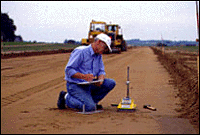 New roads and improvements The Directorate has three tasks when a new national road is to be built: Planning, project design and inspection of the construction work. The Directorate also manages improvements and expansion of the existing national road network. This may for instance include bypasses, environmentally prioritised alignments and bicycle paths. Operation and maintenance of roads The Road Directorate is responsible for the operation and maintenance of the roads in Denmark. The tasks include maintenance of the pavement wearing course, the maintenance and repair of bridges, snow clearing and the daily operation of the national roads. The Directorate handles these tasks in co-operation with other public authorities and private companies. 72,000 kilometres of road in Denmark The total public road network in Denmark has a length of 72,000 km. The municipalities are responsible for the major part of the Danish roads, with 60,000 km. The counties are responsible for approximately 10,000 km, while the Government is responsible for the remaining approximately 1,650 km of road.
The illustration shows the distribution of the responsibility for the roads in Denmark. The Road Directorate manages the major part of the national roads, but a total of 27 kilometres are managed by the government corporations of Great Belt PLC and Oresound PLC. The motorway network covers a distance of 900 kilometres, and expressways make up 150 kilometres. Besides this, there are approximately 1,305 large and small bridges and tunnels integrated in the national road network. Sector Tasks The Road Directorate performs a number of tasks for the entire Danish road sector. The Directorate collects and processes road, traffic and accident data. The Directorate also carries out research and development of new materials, develops management systems for road and bridge maintenance, road safety, environment and traffic informatics. 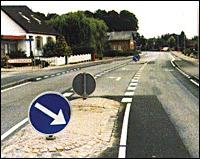 Service for road users The Road Directorate manages a number of service tasks for the benefit of road users. This may be provision of services and facilities along the road network, such as filling stations, infoterias and lay-bys. Via telecommunications, the Internet and television, the Road Directorate informs road users of Danish and foreign traffic conditions. The information may also concern new roads and traffic diversions. The Traffic Information Centre has an information line which is open to the general public. The phone number is 70 10 10 40. The line provides updated information on traffic conditions round the clock every day of the year. The Traffic Information Centre provides services for road users in the shape of itinerary planning and similar products. Areas in the Road Directorate The Directorate is split into four areas. Traffic and Transport, Operations, Construction and Sector Service. The Danish Road Institute, Informatics (IT) and the Export Department are cross-organisational units, which provide support functions for the other areas. Staff and offices The Road Directorate has a staff of approximately 450 people. The head office of the Road Directorate lies in Copenhagen. Besides the head office, the Directorate has the following branch offices: The Danish Road Institute in Roskilde, and the Construction Unit in Skanderborg. There are district offices in Roskilde, Middelfart and Skanderborg. Liaisons with the Ministry of Transport The Fourth Division of the Ministry of Transport is responsible for the liaisons with the Danish Motor Vehicle Inspection Office. |
|||
Roads in DenmarkAs a government agency, the Road Directorate is the tool used by the public, the parliament, the government and the Ministry of Transport to promote and bring about the desired development of Danish roads and thus road transport in Denmark National roads are for all of us. Hard and soft road users, public and private transport. We all expect a safe and well-maintained road network. The Road Directorate carries out this assignment. And we do so in the most economical and environment-friendly way possible. We are a modern enterprise using modern technology to construct roads that fill society's transportation needs. Together with the other players in the road and transport sectors - regional and local authorities, traffic companies, organisations and industries - it is our task to secure and promote substantial knowledge on the function of road transport and its development. This knowledge would underpin controlled and targeted efforts towards sustainable road and transport development. The interconnection between road transport and the other transport forms, rail, sea and air, is crucial to our endeavours towards creating sustainable development. Our insight into road transport conditions benefits Danish society by providing a coherent and well-functioning infrastructure adapted to citizens' and road users' requirements on reliability, safety, service, the environment, aesthetics and cost. National roads carry almost 25% of the total transport volume, i.e. general through-traffic between regions, significant ports and border crossings. Through planning, construction, operation, service and maintenance, the Road Directorate exerts a direct influence on this essential element of the Danish transport scene. Local and regional authorities manage the other approx. 70,000 km of roads, applying tools developed by or in cooperation with the Road Directorate. This calls for cross-sector cooperation in a wide range of areas.
|