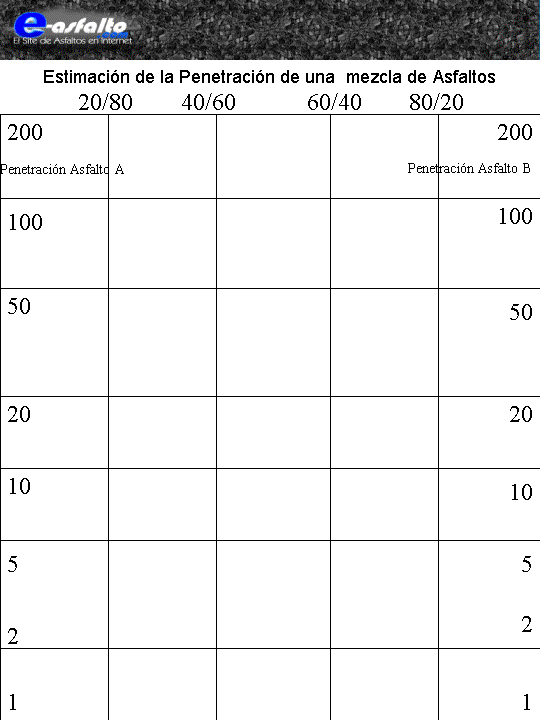
Bitumens are miscible with each other in all proportions. The penetration
and softening point of a blend of two bitumens can be estimated using the
blending charts by joining with a straight line the points an the vertical
scales giving the penetrations or softening points of the grades to be
blended and then using the horizontal scale to read the proportions of the
blend of the required proportions. These charts are quite accurate for
blends of bitumen of the same type (same PI), i.e. two penetration grades
or two blown grades. They are however, inaccurate when used for a blend of
a penetration grade with a blown grade, giving figures which are too "hard",
that is, the actual blend will have a higher penetration and a lower
softening point than the straight line, blending chart predicts. The
properties of such blends should be determined experimentally.
Bitumen/petroleum oil blends (cutbacks)
Bitumen may be mixed with a wide variety of petroleum fractions for
different applications. Volatile light fractions (white spirit, naphtha)
are used for cutbacks where rapid drying is required. Medium fractions (kerosine,
gas oil), are used where a longer drying time is permissible. Heavier cuts
(in the luboil range) are used where permanent softening is required -
these blends are virtually equal to a softer grade of bitumen.
Two general rules apply to solvents for bitumen:
* the heavier the solvent fraction, the better the solvent
* the more aromatic the fraction, the better the solvent |
 |
 |
In general, no trouble will be experienced with
any of the usual solvents far penetration grade bitumens. For blown grades,
however, aromatic solvents should be used (e.g. high aromatic white spirit, min
4590 aromatics) in order to avoid
subsequent gelling.
CAUTION. In considering bitumen solutions or cutbacks, the question of
flashpoint should always be kept in mind. As a general rule, the flashpoint of
the solution or cutback must be regarded as being the same as that of the
solvent or flux used to produce it. This can, for instance, limit the use of
fuel oil as a cheap flux. In cases where flammability (flashpoint) requirements
are critical, chlorinated hydrocarbons may be used as solvents, but they are
expensive and poisonous.
Bitumen/wax blends
Paraffix wax may be added to bitumen for two purposes:
* To reduce the viscosity when hot while leaving the low temperature properties
largely unchanged (see Figure 8, line W).
* To reduce surface stickiness (tackiness) when cold.
Paraffix wax with a melting point of about 50-60°C is usually used, at
concentrations of about 5-10% m. The wax concentration should not exceed 20%, to
avoid precipitating asphaltenes, and the wax should be added to the bitumen and
not vice versa.
Other means of reducing the tackiness of bitumen at ambient temperatures are:
* coat the surface with talc or other fine fillers
* use a harder bitumen
* incorporate an organometallic salt, e.g. 5% m of manganese resinate or lead
naphthenate.
STORAGE AND HANDLING OF HOT BITUMEN
Crust or skin formation in bitumen tanks is caused by overheating in an
oxidizing atmosphere. It may be minimized by reducing the storage temperature
and by avoiding temperature peaks caused by poor temperature control. Bitumen
should not be stored in bulk at very high temperatures. If the application
temperature is above 160°C, then only a small feed tank should be heated to this
higher temperature and the bulk storage should be kept at about 50°C above its
softening point. Inert gas blanketing with nitrogen or carbon dioxide is
effective in reducing skin formation but the cost may not be acceptable to the
customer.
Other helpful tips are:
* Make sure that any return lines in circulating systems enter the tank below
the level of the bitumen surface to reduce exposure of the bitumen to oxygen.
* Use vertical tanks in order to reduce the surface area of the bitumen exposed
to air.
* If skin or coke is being formed, stir slowly so that the carbon does not
accumulate but is used with the bitumen as rapidly as it is formed.
* Avoid inhalation of any hot bituminous vapours, particularly when sampling on
the top of hot storage tanks.
The recommended temperature limits for handling bitumen for long-term storage,
short term storage and maximum safe working conditions are as follows:
|
Recommended Temperature
Limits, °C |
|
Grade |
Long-term storage (one week or longer) |
Short-term storage or delivery |
Maximum safe working
conditions |
|
Pen and H Grades |
|
penetration > 200 |
105 |
155 |
190 |
|
100-200 |
115 |
165 |
200 |
|
40-100 |
125 |
175 |
200 |
|
penetration <40 |
140 |
190 |
220 |
|
Blown Grades |
|
R & B <80 |
150 |
175 |
200 |
|
R & B 80-90 |
160 |
190 |
|
R & B 90-100 |
175 |
200 |
|
R & B >100 |
200 |
e-asphalt.com
will be happy to quote special machines or proyect plant on receipt of details
of composition of the product, etc.
More Information Send Mail to:
info@e-asfalto.com
Copyright © 2005-10 | All Rigths
Reserved. | Home | Buenos Aires Argentina
TELFAX: 005411-4754-9374 / 6351-6288 (whatsapp) / 5931-8727